Battery drain from repeated scans, syncs, and wake-ups
Pitch brief
Make change the unit of compute.
ATOMiK makes change the unit of compute. We help constrained edge and embedded teams find wasted state movement, measure it against a real baseline, and decide whether a state-aware architecture belongs in their system.

Pain
The hidden tax in constrained compute is state movement.
Bandwidth pressure from moving full state over constrained links
Heat from redundant work before the system creates useful output
Latency from replay, reconstruction, and unnecessary state checks
The commercial question is not whether less movement sounds good. It is whether one state path is expensive enough to evaluate against a real baseline.
First wedge
The first customer has one workload, one baseline, and one painful constraint.
Battery drain from repeated scans, syncs, and wake-ups
Bandwidth pressure from moving full state over constrained links
Heat from redundant work before the system creates useful output
Latency from replay, reconstruction, and unnecessary state checks
Reference state
Meaningful deltas
Correct reconstruction
Best first fit
Edge and embedded teams, especially AI-at-the-edge, remote systems, industrial control, robotics, IoT, defense-adjacent, and hardware-constrained devices where battery, heat, bandwidth, latency, footprint, weight, or reliability is already painful.
State-heavy
Change-heavy
Constraint-heavy
Insight
State does not need to move as if everything changed.
Traditional path
Scan, move, replay, reconstruct, and repeat. This can be correct, but in constrained systems it often buys reliability with power, bandwidth, heat, and latency.
ATOMiK path
Start from reference state, track meaningful deltas, coalesce repeated work, and reconstruct only what the workload actually needs.
What ATOMiK is
A state-aware compute architecture for evidence-bound evaluation.
ATOMiK is a state-aware compute architecture that helps edge and embedded teams reduce wasted state movement by tracking meaningful change instead of repeatedly moving, scanning, syncing, replaying, or rebuilding full state.
Track meaningful change
Coalesce repeated work
Preserve correctness
OfferGive us We evaluate You receive Success looks like
Give us one workload. We will tell you if ATOMiK fits.
Give us one state-heavy workload, your current baseline, and the constraint that already hurts.
We will evaluate where state movement creates waste and whether ATOMiK can improve the path.
You will receive a workload map, baseline comparison, evidence map, fit/no-fit recommendation, and next-step plan.
Success looks like a measured improvement against one agreed metric while preserving correctness and showing enough economic or technical value to justify a design-partner evaluation.
ROI path
ATOMiK turns waste into an investment decision.
Find paid waste
Identify where state movement creates power, bandwidth, heat, latency, footprint, or engineering-time pressure.
Measure against baseline
Compare one constrained path against the current implementation, with correctness preserved and caveats attached.
Convert to next step
Use the result to decide whether the right commercial path is no-fit, proof review, design partner, licensing, or investor diligence.
Measurement
Every evaluation starts with a metric, baseline, and decision threshold.
Bytes moved
Bandwidth-constrained links, radio duty cycle, sync-heavy paths
Homepage-safe as an evaluation target
Full-state transfers avoided
Systems that repeatedly send snapshots or rebuild full state
Homepage-safe as an evaluation target
Operations coalesced
Change-heavy workloads with repeated updates to the same regions
Homepage-safe as an evaluation target
Cycles per update
Embedded processors, MMIO paths, local update loops
Proof-page-safe with artifact
Update latency
Control loops, robotics, field systems, local state machines
Proof-page-safe with artifact
Memory/state footprint
Small devices, dense local state, constrained memory
Proof-page-safe with artifact
Power proxy
Battery and thermal evaluations before instrumented power runs
Diligence-only unless clearly labeled
Thermal proxy
Enclosures, dense racks, fanless devices, field reliability
Diligence-only unless measured
Correctness preservation
Every evaluation
Homepage-safe
Proof todayHARDWARE_VALIDATED HARDWARE_VALIDATED LIVE_MEASURED SYNTHESIS_VALIDATED FORMAL_PROOF CLAIM_CONTROL
The proof is real, specific, and evidence-labeled.
Zynq Desk v0.40-A UI artifact
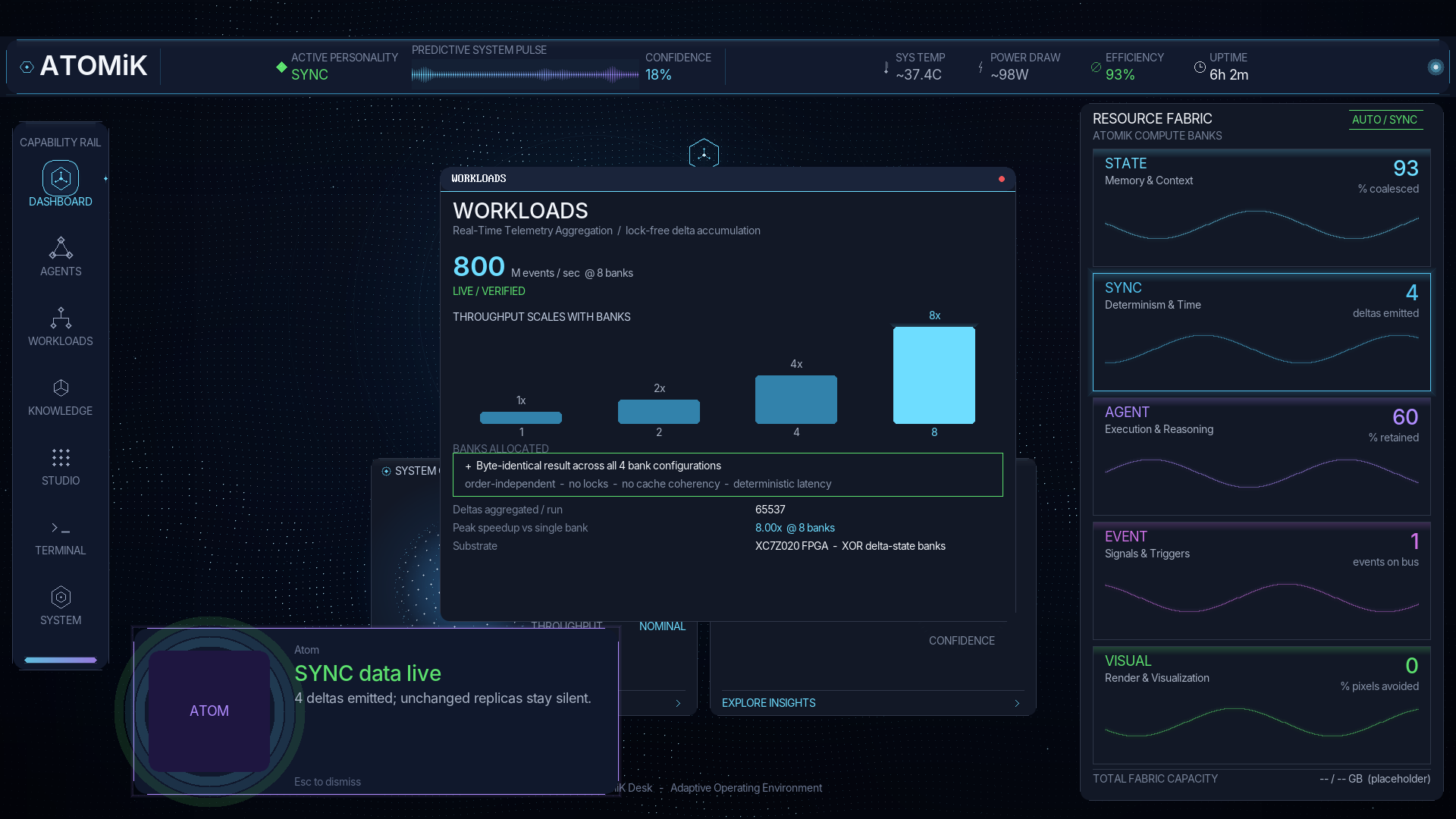
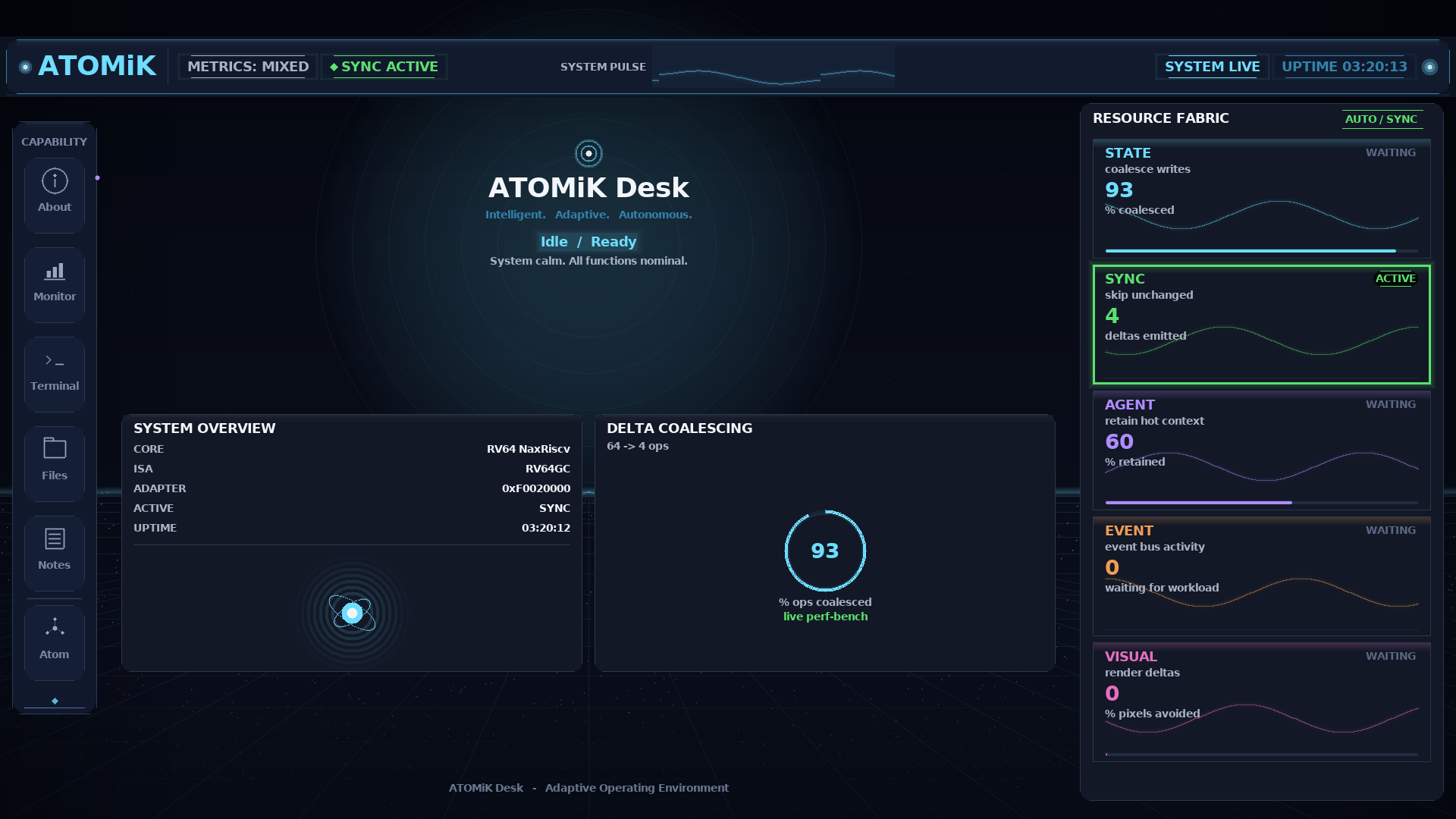
The current UI proof image shows ATOMiK Desk v0.40-A captured live from /dev/fb0 on Zynq hardware, with on-screen metrics driven by real measured on-board data. It is not a customer workload benchmark or production-readiness claim.
Linux userspace to FPGA validation
The recorded proof exercises a user process through Linux, /dev/mem, Wishbone CSR bus, and the ATOMiK core. It records 16 algebraic checks passing with zero failures.
AX7020 workload matrix
The board-run matrix shows workload-specific wins and losses. The honest pitch is that coalescing and workload personality matter.
Hardware synthesis and bank scaling
The synthesis artifact reports toolchain-characterized scaling context. It is not live-board performance proof and not production silicon proof.
Formal proof foundation
Formal proof work supports directly audited algebraic statements. It should not be expanded into workload, customer, or production outcomes.
Claims registry and labels
Public claims are separated by live measured, hardware validated, software validated, formal proof, synthesis validated, build artifact, projected, conceptual, and roadmap.
Benchmark rule: quote the artifact, context, and caveat. Do not isolate the biggest number. The proof story is artifact-bound, not a universal performance claim.
Honest benchmark story
ATOMiK wins when the workload lets architecture compound.
Step 1
Software baseline
Start with the customer's current path.
Step 2
Direct hardware
Naive hardware access can lose when MMIO overhead dominates.
Step 3
Batched ATOMiK
Batching reduces control overhead when the path allows it.
Step 4
Profiled and coalesced
Coalescing can create the major win when repeated updates hit fewer regions.
Business
Start with evaluations. Expand to design partnerships and licensing.
Proof review
Proof packet, claim boundaries, and fit/no-fit recommendation.
Technical evaluation
Workload map, metric plan, and evaluation readout.
Design-partner evaluation
Scoped collaboration around measured value and integration risk.
Licensing/IP diligence
Proof-bound IP, hardware, ASIC feasibility, and licensing review.
Investor diligence
Evidence map, paid-evaluation strategy, IP status, and ASIC feasibility path.
Status quo
The status quo buys margin instead of removing waste.
More compute
Does not remove redundant state movement.
ATOMiK differs: Targets the state movement that creates wasted work.
Bigger batteries
Does not reduce work, heat, or data movement.
ATOMiK differs: Evaluates whether the workload can spend less energy on state churn.
More cooling
Does not reduce the work that creates heat.
ATOMiK differs: Evaluates upstream redundant state work before promising thermal impact.
More bandwidth
Does not reduce transfer volume or intermittent-link risk.
ATOMiK differs: Focuses on moving meaningful change instead of full state.
Compression
May still move full state and can add CPU cost.
ATOMiK differs: Changes the unit of movement before compression is considered.
Caching
Can add invalidation complexity and stale-state risk.
ATOMiK differs: Tracks meaningful change boundaries instead of only storing copies.
RoadmapLock 2-3 design-partner evaluations Publish one sanitized workload evaluation Harden proof packet and claims registry Complete external ASIC/IP feasibility review Define licensing architecture Build repeatable evaluation tooling
The next milestone is evaluated customer proof.
Ask
Turn proof into evaluated commercial opportunity.
ATOMiK is not asking the market to accept a broad compute claim. We are asking the right customers to bring one constrained state path, measure the waste, and decide with evidence whether state-aware compute belongs in their architecture.
Next conversation
Request an evaluation, review the proof packet, discuss licensing/IP diligence, or route investor diligence through the claims and evidence map.